
Lithuania is back in Division I Group A of the IIHF World Championship after winning Group B last season. As such, that puts them in the conversation of which team will be relegated from this year’s tournament in Sosnowiec, Poland.
And indeed, the Lithuanians have dropped their first two games, but they haven’t looked bad doing it. The schedule put them up against Kazakhstan and Ukraine – two of the stronger teams in the group. Against Kazakhstan, they led 1-0 after 40 minutes before ultimately falling 4-1. Against Ukraine, they trailed 2-0 and then really came on, scoring once but losing 2-1.
“That third period was probably our best in terms of creating offence,” head coach Ron Pasco said after the Ukraine game.
Lithuania has played in Division I Group A before – in 2019, 2022 and 2023, and Pasco was at the helm for those teams. But there’s been a fair bit of turnover since then.
“I was just reading yesterday that we have four of the five youngest guys in the tournament,” said Pasco.
Those would be 18-year-old Dominykas Sadauskas and 19-year-olds Daniil Kovalenko, Simonas Valivonas and Dovydas Jukna. The team also has three others on its roster that are 21 or younger.
“That’s great,” said 28-year-old winger Emilijus Krakauskas, who’s now one of the team’s veterans. “Some of the older players are retiring and it’s great that we’ve got some new players coming in. They’re playing in good leagues around the world and they’re bringing some new energy.”
Krakauskas is right. It’s not just that the players are young, but they’re spread out all over the place. Krakauskas himself has played in Switzerland for 14 years, and the team’s roster also includes players based in Latvia, Finland, Sweden, Norway, Slovakia, Germany, France, Italy, the United States and Canada.
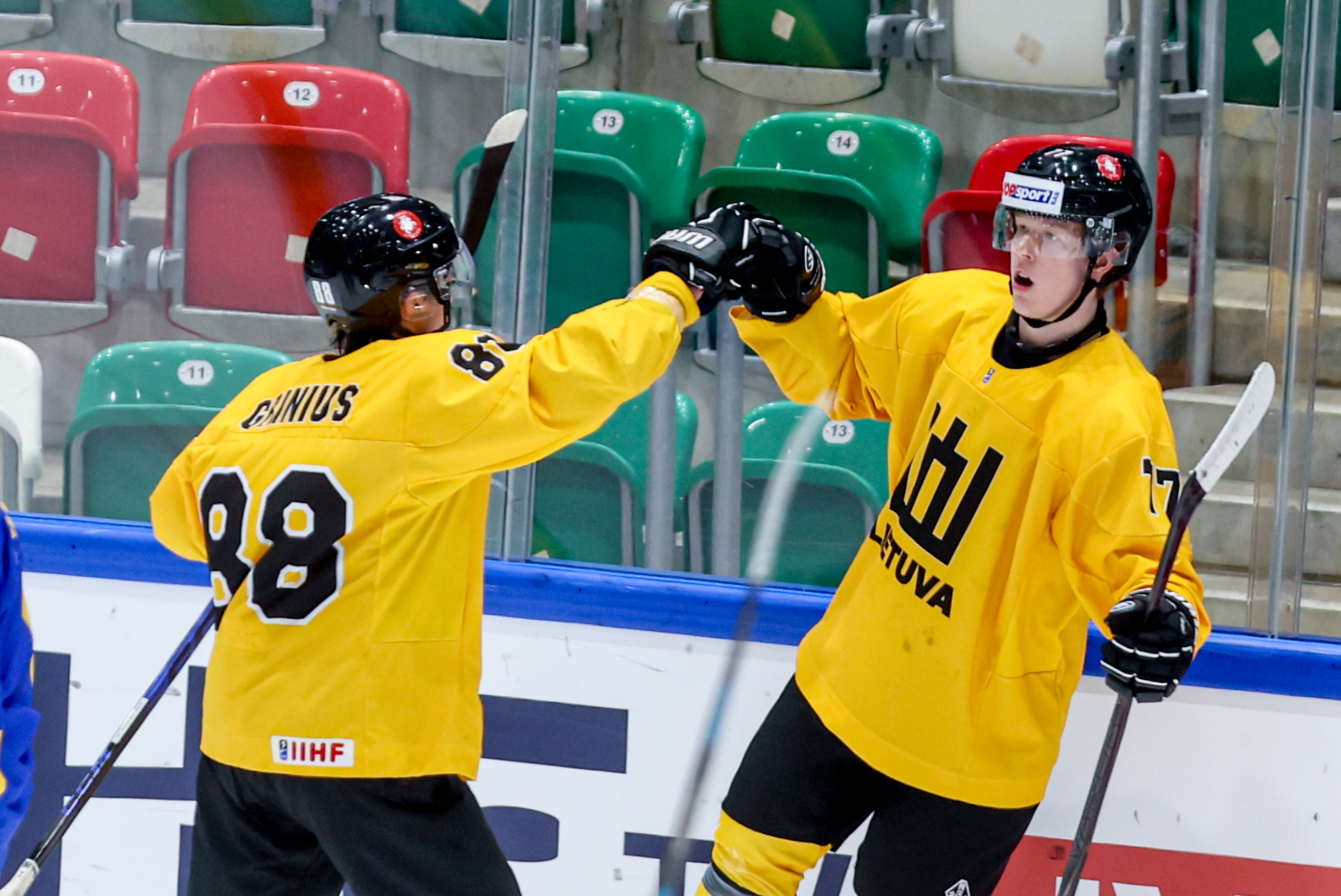
This season, for the first time ever, two North American major junior players were on the Lithuanian roster. One of them, Jukna, is here in Sosnowiec and has one of the team’s two goals so far.
“I was really excited to see that puck go in,” Jukna said of his late-second-period goal against Ukraine on Sunday that cut his team’s deficit to 2-1. “I was really happy and it also helped give the team a boost of energy. A really nice feeling. It’s just a shame we couldn’t get another goal.”
Jukna played from age 13 to 18 in Switzerland for the Geneve-Servette club, while at the same time representing Lithuania at the U18 and U20 levels. This past season, he made the big jump overseas to play for the QMJHL’s Rimouski Oceanic, where he put up 17 points in 45 games.
“It’s a really tough league, a really quick league and really different from Europe,” Jukna described the Q. “It takes some time to adjust. I started really well and then there were some ups and downs, but that’s normal for a European player trying to adjust.”
On now playing international hockey at the senior level, he said, “I really like playing here with experienced players from all over the world in really good leagues – really solid players and really good teammates that push me, teach me new stuff about pro hockey. I’m really excited to be playing in this tournament.”
“We’ve got a young group but we’ve got some good leadership as well, so we’re trying to blend that together,” said Pasco. “That’s kinda the nature of our program.”
In addition to Krakauskas, some of the other veterans who have been on the team for several years include captain Nerijus Alisauskas, who plays in Slovakia, Ugnias Cizas, who plays in the German third division, Paulius Gintautas, who plays in Norway, and Aivaras Bendzius, who scored the team’s first goal of the tournament against Kazakhstan.
“We’re a small community and we don’t have thousands and thousands of players to choose from,” said Pasco. “I think as the team continues to grow, that’s our goal, day by day, and hopefully our best is yet to come.”
Can Lithuania stay up?
The double promotion is not unheard of in Division I. Great Britain and Poland have both done it in the last eight years, winning Group B, then Group A, to reach the top flight. Ukraine came within a whisker last year. But the fact that Lithuania has dropped its first two games almost certainly takes that off the table for this year.
“That’s probably not where we’re at at this point,” Pasco agreed. “But certainly, we’re going to do everything we can to make sure we can stay in this group. I think that’s a bit more realistic.”
The only other winless team at the point is Japan, and after a day off, the two teams face each other in what’s shaping up to be a huge game on Tuesday.
“Well, they’re all big games,” Pasco smiled. “I see where you’re going with this.”
While a loss in regulation time wouldn't relegate either team, it would require them to get at least four points from their last two games, while hoping the other team gets blanked.
“We’re just trying to establish ourselves at this level – that’s a big challenge for us – and we’re just going to leave it all on the ice coming up in our next game.
“We’ll pre-scout them and analyze how they play,” said Jukna. “We’re going to work on taking less penalties and the details – the small mistakes we made against Kazakhstan and Ukraine – that could change the game against Japan. I think we’ll be ready after the big rest.”
“We prepare for every game exactly the same,” said Krakauskas. “It doesn’t matter who we play against. In the end, we’ve gotta win games and we’re going to give it our all every game and see what happens.”